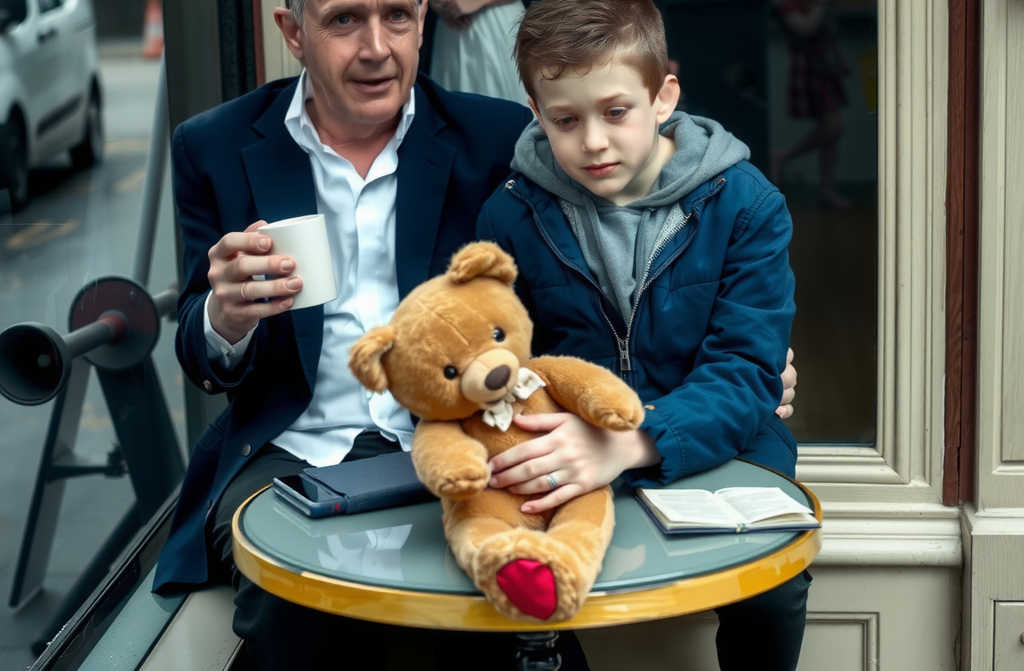
James Caldwell had it all: wealth, status and a sprawling estate tucked into the hills on the edge of Oxford. Hed founded one of the most successful cybersecurity firms in the Cambridge tech corridor and spent almost twenty years building his empire. Yet, despite his triumphs, an emptiness lingered in his grand housean absence that no vintage Bordeaux nor the priciest painting could ever fill.
Every morning James took the same route to his office, winding through the historic quarter of the city. Lately a group of homeless youngsters had begun to gather outside a small bakery on High Street, its window display festooned with framed photographs of local weddings. One picture in particularhis own wedding shot taken a decade earlierhung proudly in the topright corner of the glass. The bakerys owners sister, a parttime photographer, had taken it, and James had allowed it to be shown because it captured the happiest day of his life.
That happiness, however, proved fleeting. His wife, Eleanor, vanished six months after their wedding. No ransom note, no trace. The police labelled the disappearance suspicious, but without evidence the case went cold. James never remarried. He buried himself in work and erected a digitally impenetrable life, yet his heart remained haunted by the unanswered question: what had become of Eleanor?
One rainy Thursday morning, James was driving to a board meeting when traffic slowed near the bakery. He glanced through the tinted windshield and saw a barefoot boy, no older than ten, soaked by the drizzle, staring intently at the wedding photograph in the shop window. James watched without much thought until the boy pointed straight at the picture and told the baker, Thats my mum.
Jamess breath caught.
He rolled his window down halfway. The lad was thin, his dark hair tangled, his shirt three sizes too big. James studied his face, feeling an uneasy knot tighten in his stomach. The boys eyes were the same soft hazel that Eleanors had always been, flecked with green.
Hey, lad, James called out. What did you just say?
The child turned, blinked, and repeated, Thats my mum, pointing again at the photo. She used to sing to me at night. I remember her voice. One day she just vanished.
James stepped out of the car, ignoring the drivers nervous glance. Whats your name, son?
Liam, the boy answered, trembling.
Liam James knelt to his level. Where do you live?
The boy lowered his gaze. Nowhere proper. Sometimes under a bridge. Sometimes by the railway line.
Do you recall anything else about your mum? James asked, trying to steady his voice.
She liked roses, Liam said. And she wore a little necklace with a white stone, like a pearl.
Jamess heart sank. Eleanor had always worn a single pearl pendant, a gift from her mothera distinctive piece that was hard to forget.
I need to ask you something, Liam, James said slowly. Do you remember your father?
The boy shook his head. Never met him.
At that moment the baker emerged, curious about the commotion. James turned to her. Had you seen this boy before?
She nodded. He comes by now and then. Never asks for money, just stands looking at that photo.
James called his assistant and cancelled the meeting. He took Liam to a nearby café and bought him a hot sandwich. Over lunch he peppered the boy with more questions. Liam could only offer fragments: a woman singing, an apartment with green walls, a teddy bear named Max. James sat there, stunned, as if fate had finally handed him a missing piece of a puzzle he thought irretrievably broken.
An DNA test would soon confirm what James had suspected deep down.
But before that, a question kept him awake that night:
If this boy is his, where had Eleanor been for ten years? And why never returned?
The DNA results arrived three days later. The verdict struck James like a bolt of lightning.
99.9% match: James Caldwell is the biological father of Liam Evans.
James sat in stunned silence as his assistant placed the report on the table. The ragged, silent boy who had pointed at a wedding photograph in a bakery window was his sona child he never knew existed.
How could Eleanor have been pregnant? Shed never mentioned it. Yet she disappeared only six months after the wedding. If shed known, perhaps shed have found a way to tell him. Or perhaps someone silenced her before she could.
James hired a private investigator. With his resources, he quickly engaged a retired detective, Arthur Briggs, who had once worked on Eleanors missingperson case. Briggs was wary of returning to Jamess world, but the new development intrigued him.
The trail went cold back then, Briggs said. But a childs mention changes everything. If someone was protecting a baby it could explain the disappearance.
Within a week Briggs uncovered something James never expected.
Eleanor hadnt vanished completely. Under the alias Marie Evans she had been spotted in a womens shelter two villages away eight years earlier. The records were vague, likely for privacy, but one stood out: a photo of a woman with hazelgreen eyes cradling a newborn. The babys name? Liam.
Briggs traced her next whereabouts to a small medical clinic in Kent. She had registered for prenatal care under a false name, left midway through treatment and never returned. From there she disappeared again.
Jamess pulse quickened as the clues piled up. Shed been running. From what?
The breakthrough came from a sealed police report naming Derrick Blake, Eleanors former boyfriend. James recalled him faintly; hed never met the man, but Eleanor had once described Derrick as controlling and manipulative, someone shed broken off with before meeting James. What James didnt know was that Derrick had been released on parole three months before Eleanors disappearance.
Briggs found court documents showing Eleanor had obtained a restraining order against Derrick just two weeks before she vanished, but the paperwork was never processed and no protection followed.
The theory fell into place: Derrick tracked Eleanor down, threatened herperhaps even assaulted herand, fearing for his own safety and for the unborn child, fled, assuming a new identity.
Why then was Liam out on the streets?
A second twist emerged: two years earlier officials had declared Eleanor legally dead. A body had been found in a nearby inlet; its clothing matched what Eleanor had worn on the day she disappeared, so the police closed the case. Dental records, however, were never compared. It wasnt her.
Briggs tracked down the woman who ran the shelter where Eleanor stayed eight years ago. Her name was Caroline, now elderly, and she confirmed Jamess worst fear.
Eleanor arrived terrified, Caroline recalled. She said a man was after her. I helped her give birth to Liam. Then, one night, she vanished. I think someone caught up with her.
James could not speak.
Then the phone rang.
A woman matching Eleanors description had been arrested in Portsmouth for shoplifting. When her fingerprints were run through the national database, an alert linked her to a missingperson case from a decade earlier.
James boarded a flight that night.
At the detention centre he stared through the barred window at a pale woman with haunted eyes. She looked older, thinner, yet unmistakably Eleanor.
Emily. (He had been calling her by her maiden name.)
He turned, his hand shaking as he reached for the glass. Tears streamed down his cheeks.
I thought you were dead, James whispered.
I had to protect him, Eleanor replied, voice breaking. Derek found me. I ran. I didnt know what else to do.
James escorted her home, cleared the minor charge, arranged counseling, and most importantly reunited her with Liam.
When Liam saw his mother again, he didnt speak. He simply walked forward and threw his arms around her.
Eleanor, after ten years of hiding, fearing, fleeing, collapsed into her sons embrace and wept.
James formally adopted Liam. He and Eleanor took their time, rebuilding trust and healing from the trauma. Eleanor testified against Derek, who was later arrested on a separate domesticviolence charge, prompting the reopening of the original case and finally delivering justice.
James often found himself glancing at that wedding photograph in the bakery window. It had once symbolised loss. Now it stood as a testament to love, survival and the strange, miraculous way fate had stitched his family back together.
Leave a Reply